I keep waiting for the part where AI made my teams quieter. It hasn’t happened. If anything, we talk more than ever now — and I’ve finally stopped being surprised by that.
When everyone started predicting that AI would turn engineering into a solo sport — one person, one agent, head down, shipping — I half believed it. That’s not how it played out for us at Oddball. Here’s what actually changed about the way we work, and the thing nobody warned me about.
Two weeks, on purpose
I’ve never really thought of sprints as a speed thing. The way I’ve come to see them, they’re about rhythm — build, step back, look at it with fresh eyes, decide whether it’s any good. That’s the part I’ve always cared about, long before AI was in the picture.
What AI changed is the building. Things get made so fast now that, taken literally, we could run a new sprint every day. We don’t — and that’s the deliberate part. Speed was never our real constraint. The constraint is how long it takes to process what we made and feel out whether it actually means anything. So the two-week cycle is an emotional barrier we kept on purpose. It buys us fresh eyes, and the time and space to create instead of just crank.
So we do more, not faster
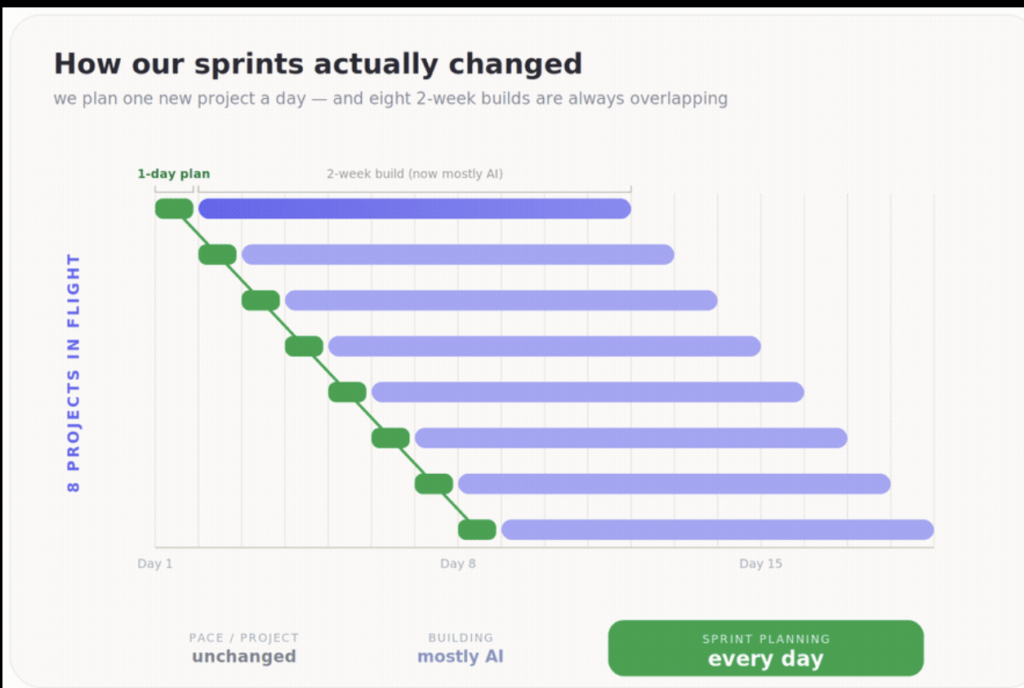
Here’s the twist AI actually created. When building each thing takes a fraction of the people it used to, you open up room inside the cycle — days that need filling. We didn’t spend that room by going faster. We spent it by doing more. Same two-week cadence, more things running inside it: we went from all-hands on one project to eight in parallel, without it feeling chaotic. The brain still gets to rest and reflect between cycles — we just point it at eight things now instead of one.

Same two-week cadence, just more of it at once — our sprints now run staggered and in parallel rather than one at a time.
The real silo AI created
The old way had a hidden gift: building anything meaningful took five engineers, so collaboration was forced. You couldn’t not know what everyone was working on.
AI quietly removed that. Now one person and an agent can build a whole thing start to finish — alone. That’s efficient, and it’s also the new silo: one head, one set of assumptions, nobody else in the room to ask “wait — is this actually good?” It’s sneakier than the old kind, because it looks exactly like productivity.
So we break it on purpose, in the most fun way we’ve found. The thinking-like-a-user part — the design, the “would I actually want this?” — used to be a luxury we squeezed in at the edges. Now it’s where the whole team comes together. We each step out of builder mode and into the user’s chair, which keeps us close to what everyone else is making and keeps the work honest.
The surprise: we think more, not less
Here’s the part I didn’t see coming. Making the building cheap made us spend more time thinking and talking about what to build — and I’ve come to believe that’s the whole point.
There are two easy ways to get this wrong. One is letting one person and an agent run a thing all the way to “done” with no conversation behind it — you get coherent-looking output nobody actually agreed on. The other is spinning up yet another app just because you now can, which is its own quiet kind of waste. The talking is what sits between those two failure modes. It’s the part that decides whether all that cheap building is worth anything.
So our sprints got more conversation-heavy, not less. Fewer hours typing in isolation, more hours figuring out together what’s actually worth making.
Yes, some days, it’s a lot of meetings
I won’t pretend it always feels great. Some days it’s straight-up meeting fatigue. But here’s what we learned the hard way: without the talking, we drift. The projects start to wander, and even what we mean by each one slowly comes apart. So we stay in it on purpose, fatigue and all.
And then there’s the payoff. The moment we finally see the working thing — and the rest of the group reacts to it for the first time — it’s kind of magic. That reaction is what all the talking was buying the whole time. We just didn’t know that’s what we were paying for.
What actually got cheap
So if you’re rethinking how your team works as these tools get good, here’s the honest version from where I sit: the building got cheap. That’s real, and it’s great. But it didn’t make the thinking optional — it made it the job. The teams that win the next couple of years won’t be the ones who ship the most apps the fastest. They’ll be the ones who got good at deciding, together, which apps were worth shipping at all.
And the output is real, for what it’s worth — our Labs group now ships up to 100 products a year, a number that would have sounded delusional to me not long ago. But I want to be careful about how I say that, because the count was never the thing I was proud of. It’s the byproduct of getting the deciding right, not the goal we chase.
For us, the thinking together turned out to be the best part. I’ll take meeting fatigue over drifting in silence any day.
—
This is how one corner of Oddball is working right now — your mileage will vary, and we’d genuinely like to hear how it’s going for your team. Follow along here for more on how we’re building (and rebuilding) the way we build.
About the Author
Agata Ciesielski is VP of Architecture at Oddball, where she helps teams rethink how they build software in the age of AI agents. She’s published research on human–robot interaction and machine learning (IEEE, SPIE) and writes about AI, IP, and design — including the “Vegan AI” series on Medium.