The price of AI just went up.
The assumption was that AI would follow the usual curve: models get better, costs fall, everyone wins. That happened for a while. Then Anthropic’s Fable model dropped, and the best model on the market is now also one of the most expensive to run at scale.
Here’s the math that’s keeping me up. A capable coding agent using fable runs about $43/hr in tokens when you point it at real work. That’s roughly 25% more than an overseas developer. An agent may be faster and never sleep, but it is a line item, and it’s growing, and someone has to own it.
The era of AI being a small % of the budget is closing. When your token bill starts rivaling payroll, it stops being an IT curiosity and becomes a finance problem.
AI cost is a CFO problem now
The CFO’s job has always been two things: manage risk and control expenses. AI hits both, hard.
The risk side is obvious once you look. You’ve got a vendor you can’t easily swap, pricing that moves under you, and usage that can spike 10x in a week because one team wired an agent into a loop. The expense side is worse, because right now most companies genuinely can’t see what they’re spending or why.
Finance startup Ramp is already moving into this space providing visibility and tracking of tokens and model usage, and treating it like any other category of spend. That tells you where this is headed. The tooling is catching up because the problem got big enough to fund the tooling.
Other industries would never put up with this
Think about how mature spend categories actually bill.
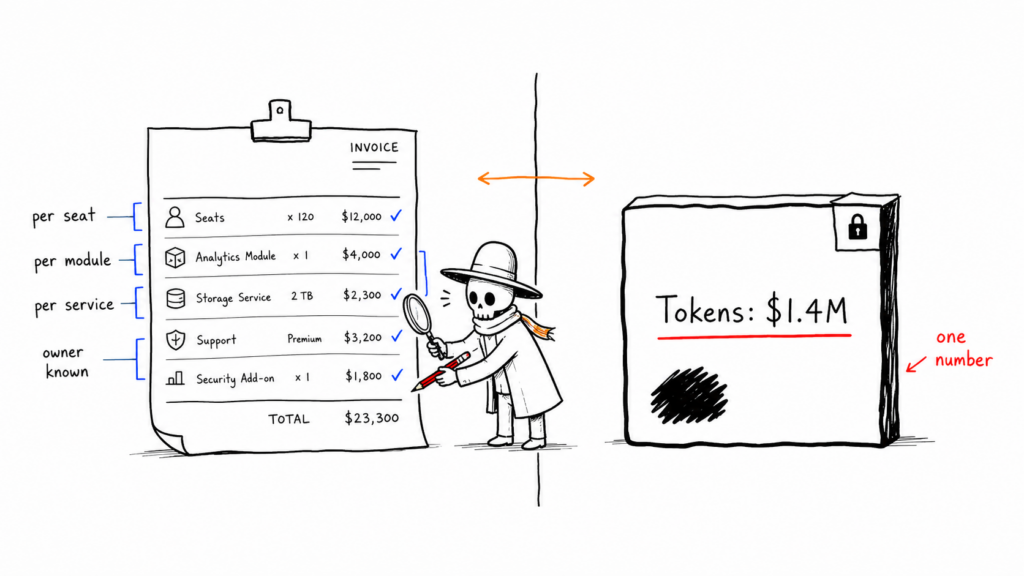
SaaS figured this out decades ago. You get licenses, tiers, usage-based pricing, a breakdown by module and by seat. A finance team can look at a SaaS invoice and tell you which department is driving the cost and whether it’s worth it.
Facility management is even more granular, and it’s not a software business. Janitorial, craft services, rent, utilities, all broken out, all attributable. You don’t hand a building owner one giant number and say “trust us.”
AI hands you one giant number and says trust us.
You burn through millions of tokens across a dozen teams and use cases, and at the end of the month you get a single bill with almost no idea which work justified it. No mature finance org would accept that for any other category. We accept it for AI because it’s new and the numbers are small. Both of those excuses are expiring.
Where tech and finance collide
There’s a real friction building between the people who use these tools and the people who pay for them. Up into now, we were buoyed along by cheap subscriptions, but with fable we are buying force to think more deeply about it
There is a comforting technical naivety to using the most powerful model for every job. It feels responsible, like always buying the safest car. But you don’t need a frontier reasoning model to reformat a CSV or draft a standup summary. You’re paying Ferrari rates to run errands.

The right model for the right job is the whole game. A lot of the cost problem isn’t usage, it’s bad routing. Cheap models for cheap work, expensive models for the 10% that actually need the horsepower. Most teams haven’t built the muscle to make that call yet, so they default to “use the best,” and the bill reflects it.
So whose responsibility is this?
It’s partly a technical decision: you need engineers who understand model capabilities well enough to route work intelligently and to set guardrails on runaway usage.
But honestly, a big part of this is vendor and spend management, and that’s a discipline finance and operations already own. Picking the right contractor for a physical IT buildout. Knowing the right way to buy SaaS tools. Negotiating, tracking, and attributing spend. AI isn’t exempt from that playbook just because it’s clever.
My read: this lands in the gap between the CTO and the CFO, and the companies that win will be the ones who get those two in a room early. Treat tokens like any other input cost. Demand visibility. Route work to the right model. Manage the vendor like you’d manage any vendor holding a growing line on your P&L.
The technology is genuinely remarkable. That’s exactly why the spend deserves to be managed like it matters.
Here at Oddball labs our products helps solve this problem. It focused on AI governance: what data is being accessed? Who’s doing it? What models are they using? Visibility first, then optimization.
About the Author
Rob Wilkinson is CTO and Cofounder at Oddball, leading Oddball labs and focusing on high impact products and engagements in the age of AI agents.